
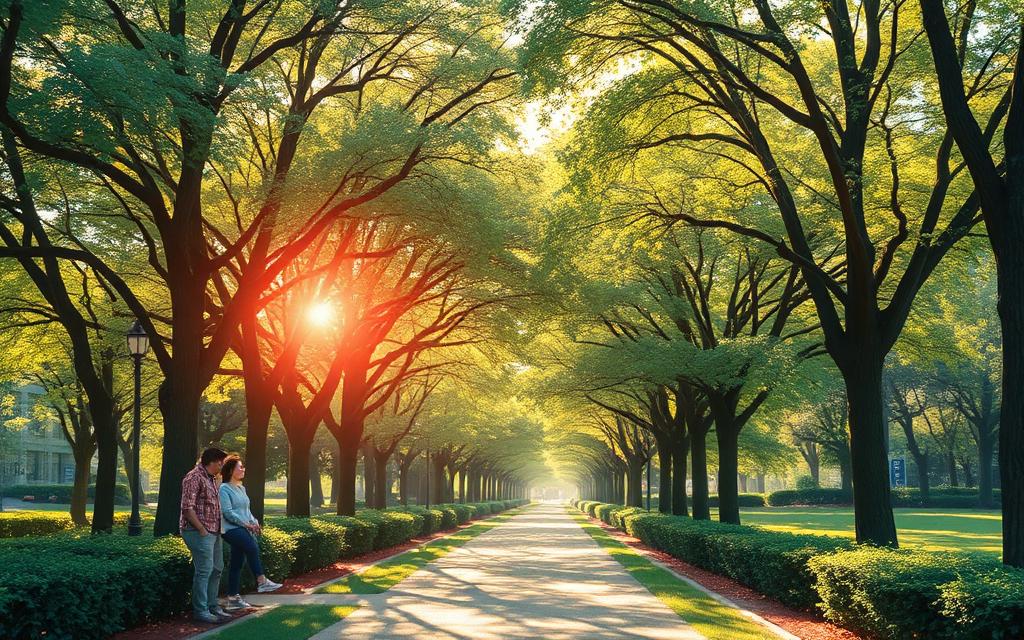
Shinrin-yoku, the Japanese practice of forest bathing, has been studied seriously since the 1980s. Most of the headlines focus on dense old-growth forest because that is what the original Japanese protocols used. The more practical news is that you do not need that much nature to get most of the benefit.
The numbers
A 2019 meta-analysis in Environmental Research, pooling 14 trials, found that forest walking produced statistically significant reductions in systolic and diastolic blood pressure, salivary cortisol, and heart rate, compared to matched urban walking. The effect sizes were modest but consistent.
A separate body of research on urban green spaces (parks, tree-lined streets, even small courtyards) shows that the same physiological signals shift in the same direction, just less dramatically. A 2018 review in the International Journal of Environmental Research and Public Health concluded that even 15 to 20 minutes in a green urban setting was enough to register measurable benefit.
Why this works
Two main mechanisms. First, attention restoration: natural settings let your top-down attention system rest, which lowers cognitive load and stress. Second, sensory: green light, organic shapes, and the smell of plants (including volatile compounds called phytoncides) appear to directly influence stress hormones.
How to install green walks
- When picking a route, choose the greener street even if it is slightly longer.
- Eat lunch in a park instead of at your desk twice a week.
- On weekends, default to a tree-rich route for at least one walk.
Take Bubbles for a green walk. He gets his bigger world. You get your lower blood pressure.
Download BubblesThe cheapest blood pressure medication is a sidewalk with trees on it.
Sources
Bubbles turns every step into clearer water, a meal, and a bigger world for a tiny fish who is genuinely glad you came.
Download Bubbles